
Introduction
Starting a business takes more than an idea. New startups often need money to build their products, test their ideas, study the market and show their solutions to customers. Getting funds at the early stage can be hard, especially for founders who are not yet known in the market.
To fill this gap, the Government of India started the Startup India Seed Fund Scheme (SISFS) under the Startup India initiative. The scheme gives money to startups for proof of concept, prototype building, product trials, market entry and commercialisation.
Through this effort, the government backs business ideas by giving seed money through selected incubators. Learning about the Startup India Seed Fund Scheme, who can apply and how to apply can help founders see whether their business can get this help.
Current status (November 2026): The official SISFS portal set 31 May 2026 as the last date for startup applications, and that window has closed. No new call for applications had been announced at the time of writing. Founders should keep checking the official Seed Fund portal and prepare now, so they are ready when applications reopen.
What Is the Startup India Seed Fund Scheme?
The Startup India Seed Fund Scheme, abbreviated SISFS, is a government programme launched by the Department for Promotion of Industry and Internal Trade (DPIIT) to help startups that are just beginning in India.
SISFS was started with a corpus of ₹945 crore. This money is meant to help startups that need early capital to test and grow their business ideas.
SISFS is different from many other funding programmes. Instead of giving money directly to applicants, SISFS works through selected incubators. The scheme:
- Supports startups during the early stages of business development.
- Helps entrepreneurs prove that their ideas can work.
- Provides money for building prototypes and running product trials.
- Supports startups as they enter the market and commercialise their products.
- Encourages innovative, technology-based business solutions.
SISFS does not limit itself to any one sector. Startups from all industries can apply if they meet the eligibility rules.
What Financial Assistance Does the Startup India Seed Fund Scheme Provide?
The seed fund for startups under SISFS is provided in two ways, based on the stage of development and the funding needs of the business.
| Support | Amount | Used For |
|---|---|---|
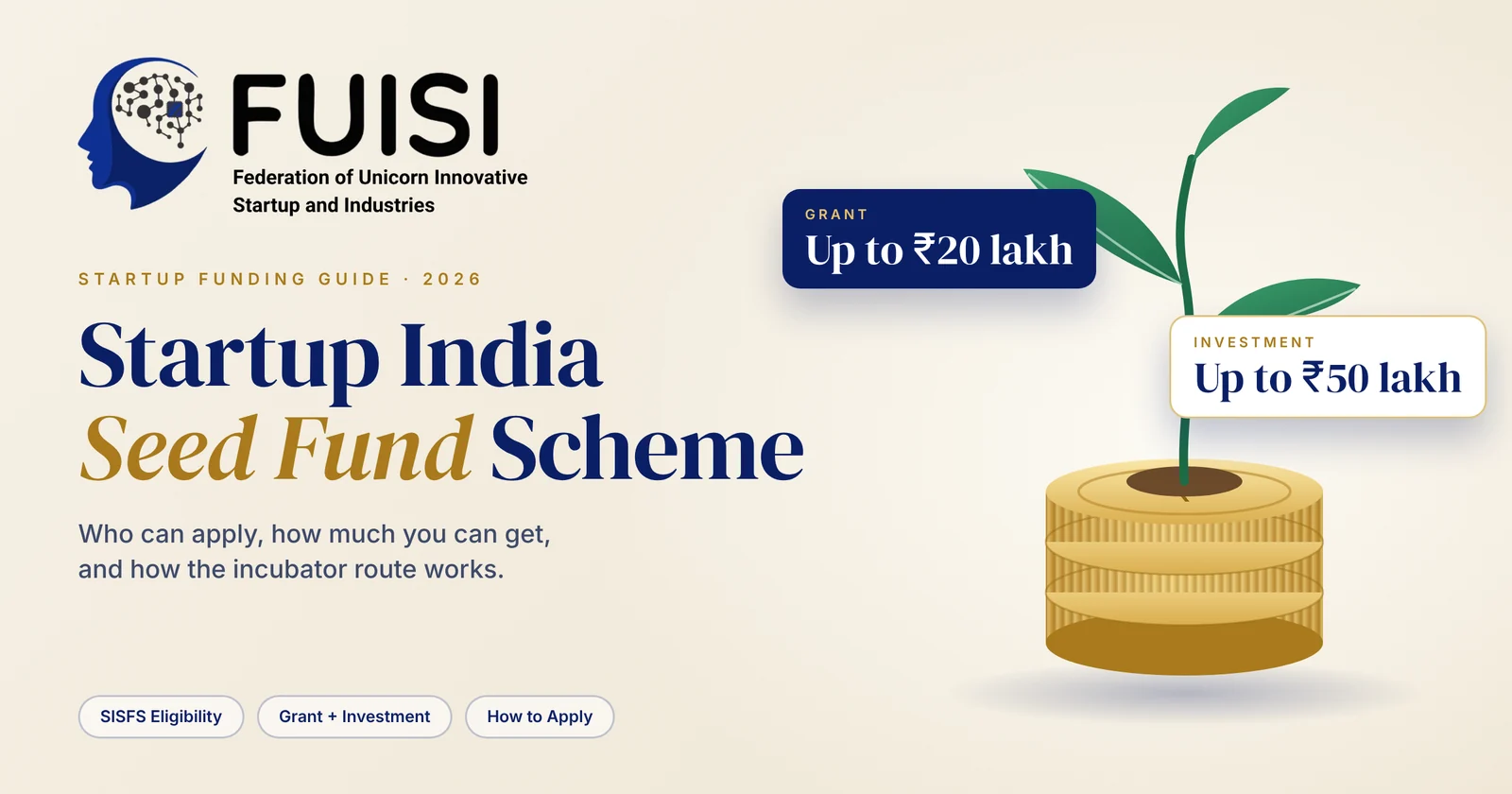
| Grant | Up to ₹20 lakh | Proof of concept, prototype development and product trials |
| Investment | Up to ₹50 lakh | Market entry, commercialisation and scaling up, through convertible debentures, debt or debt-linked instruments |
1. Grant of Up to ₹20 Lakh
Startups that qualify can get a grant of up to ₹20 lakh. This grant supports activities like:
- Validating the proof of concept.
- Developing a prototype.
- Testing the product and running trials.
The grant is released in instalments, based on milestones. Startups must show they have achieved the goals set out in their plan to receive each payment.
2. Investment of Up to ₹50 Lakh
Startups that are ready to enter the market, commercialise their product or scale their operations can get investment support of up to ₹50 lakh. This support can come in the form of:
- Convertible debentures.
- Debt.
- Debt-linked instruments.
The goal is to help startups move past the development phase and start offering their product or service to customers. An eligible startup can get grant support once and investment support once, as long as it follows the rules of the scheme.
SISFS Eligibility: Who Can Apply for the Scheme?
Understanding SISFS eligibility is important before submitting an application. The scheme is designed for early-stage startups that have business ideas and need financial support to develop their products or services. To qualify, a startup must meet these conditions:
1. DPIIT Recognition Is Mandatory
The startup must have valid recognition from the Department for Promotion of Industry and Internal Trade (DPIIT). DPIIT recognition establishes that the business meets the government's definition of a startup.
2. Incorporated Not More Than Two Years Ago
The startup must have been incorporated not more than two years before the date of application under SISFS. This ensures that the scheme supports businesses at their early development stage.
3. The Business Idea Must Have Commercial Potential
The startup should have a business idea for a product or service with:
- Market fit.
- Commercialisation potential.
- Scope for future growth and expansion.
The proposed solution should address a real market need or business problem.
4. Technology Should Be Part of the Business Solution
The startup should use technology in at least one of these:
- Its core product or service.
- Its business model.
- Its distribution model.
- The methodology used to solve the identified problem.
5. Limit on Other Government Funding
The startup should not have received more than ₹10 lakh in monetary support under any other Central or State Government scheme. Some forms of assistance are not counted in this limit, including prize money from competitions and grand challenges, subsidised working space, founder monthly allowances and access to laboratories or prototyping facilities.
6. Indian Promoters Must Hold at Least 51%
The shareholding of Indian promoters in the startup must be at least 51% at the time of application to the incubator under the scheme.
7. Funding Cannot Be Availed Repeatedly
A startup cannot receive seed support more than once under each of the two funding categories in the scheme guidelines: grant assistance and debt or convertible debenture support.
Which Startups Receive Preference Under SISFS?
The Startup India Seed Fund Scheme is open to startups in all sectors, but some kinds of businesses get priority. These are the ones building solutions to major economic and social problems, in areas such as:
- Agriculture and food processing
- Education
- Biotechnology
- Financial inclusion
- Waste management and water management
- Renewable energy and energy efficiency
- Transportation
- Space
- Textiles
- Railways, oil and gas
Startups in these areas may get an edge when their applications are reviewed. However, being in a priority sector does not guarantee funding. The startup still has to meet every eligibility rule.
How to Apply for the Startup India Seed Fund Scheme When Applications Reopen
Applications for the Startup India Seed Fund Scheme are made online through the official Seed Fund portal. Here is how the process works.
Step 1: Obtain DPIIT Recognition
Before you apply, make sure the startup has DPIIT recognition. If the startup is not yet recognised, it must first complete the free recognition process on the National Single Window System (NSWS).
Step 2: Select Suitable Incubators
You can send the startup's application to up to three incubators that are part of the scheme, in order of preference. Choose incubators that know your industry, have the right facilities and match your business model.
Step 3: Complete the Application Form
Enter all required details about the startup, the founders, the business model, the product or service and how much funding the startup needs. Make sure the information is correct and that every required field is filled.
Step 4: Submit Supporting Documents
Upload the documents and business information that the portal asks for. Depending on the application, these may include proof of recognition, incorporation papers, a business plan, financial data and a plan for how the startup will use the funds.
Step 5: Application Evaluation
The selected incubators review applications through their Incubator Seed Management Committee (ISMC). The committee looks at:
- The market need for the product and the startup's business potential.
- Whether the product can be commercialised.
- How new and unique the solution is.
- The possible impact of the product or service.
- The skills of the founding team.
- How the seed money will be used.
Step 6: Selection and Fund Disbursement
After the review, selected startups receive funding through their incubators. The money is released based on the approved amount, the milestones the startup meets and the conditions of the scheme.
Important Things to Know Before Applying
- No fee to apply: The scheme does not charge startups any application fee. Incubators also cannot charge applicants or beneficiaries for selection, disbursement, hosting or monitoring under this scheme.
- No need to be on site: Startups do not need to be physically located at the incubator. Monitoring can be done remotely.
- Funding is not promised: Meeting the rules does not mean you will be selected. Applications are judged on the business idea, its novelty, its feasibility, the strength of the team and the funding needed.
- Funds must be used as approved: The financial help has to be spent on the purpose for which it was given.
- Check the current window: The last date for the previous application window was 31 May 2026. Check the official portal for any new notice before you apply.
How FUISI Can Help
While SISFS applications are closed, founders can still prepare and explore other routes. FUISI's Gov Schemes Portal helps founders find schemes that match their startup, and FUISI's advisory team helps members prepare applications. Our complete 2026 guide to startup funding in India covers angel investors, VCs and the Fund of Funds, and FUISI's Startup Mission connects young founders with mentors and incubation support.
Frequently Asked Questions (FAQs)
1. Who is eligible for the Startup India Seed Fund Scheme?
DPIIT-recognised startups that were incorporated not more than two years before the date of application can apply. They must also meet the conditions on innovation, use of technology, other government funding and Indian promoter shareholding.
2. How much funding is available under SISFS?
Eligible startups can get a grant of up to ₹20 lakh for proof of concept, prototype development and product trials, and investment support of up to ₹50 lakh for market entry, commercialisation and scaling up.
3. Is the Startup India Seed Fund Scheme open now?
The last date for startup applications in the previous window was 31 May 2026, and no new call had been announced at the time of writing. Keep checking the official Seed Fund portal for updates.
4. Is DPIIT recognition mandatory for SISFS?
Yes. DPIIT recognition is required. Individual entrepreneurs without a recognised startup cannot apply on their own.
5. How many incubators can a startup apply to?
A startup can apply to up to three participating incubators, listed in order of preference.
6. Is there any application fee for the scheme?
No. There is no fee to apply under SISFS, and incubators are not allowed to charge fees for selection and funding.
7. Can startups from any industry apply?
Yes. SISFS covers all sectors, although startups in priority sectors are given preference.
Conclusion
The Startup India Seed Fund Scheme is a valuable funding opportunity for early-stage startups that want to build new products, test their business ideas and enter the market. With up to ₹20 lakh in grants and up to ₹50 lakh in investment support, the scheme addresses one of the biggest problems early founders face.
Knowing the eligibility rules, preparing your business details and shortlisting the right incubators will put you in a strong position when applications reopen. By understanding the Startup India Seed Fund Scheme now, founders can plan their early growth with confidence.