Introduction
Women entrepreneurs are becoming an important part of India's business world and startup ecosystem. They run shops, factories, tech companies and service firms across many fields. Yet getting money, advice and contacts can still be hard for many new business owners.
To help women entrepreneurs grow, the Government of India offers financial assistance programmes, credit options and business support. Knowing the right schemes for women entrepreneurs helps business owners find the funding and help they need.
This guide looks at the key government schemes for women in 2026, including loan options, credit guarantees and subsidy-linked programmes, and explains how to apply.
Government Schemes for Women Entrepreneurs at a Glance
| Scheme | Type of Support | Key Benefit |
|---|---|---|
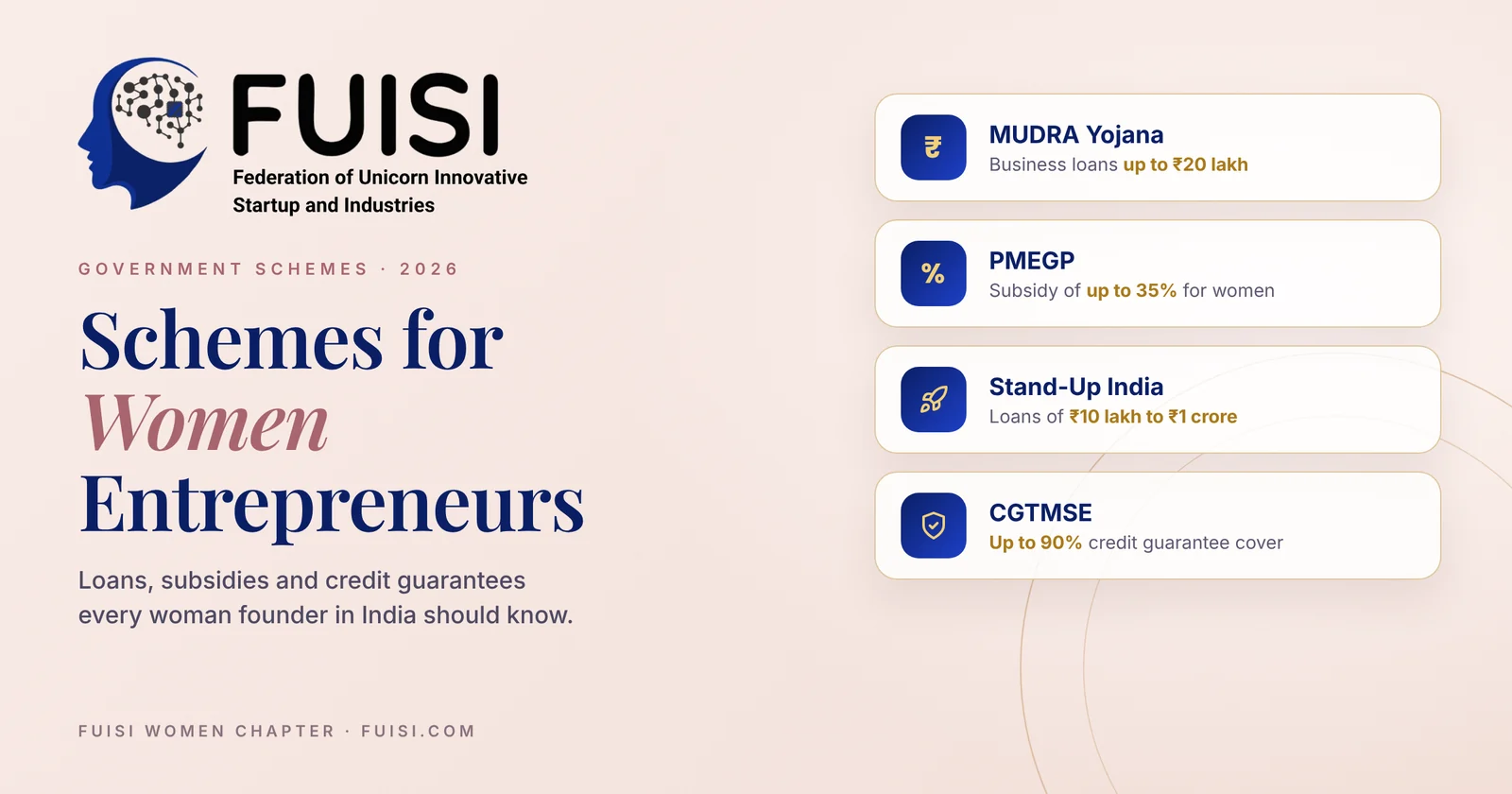
| PM MUDRA Yojana | Business loans for micro and small units | Loans up to ₹20 lakh (Tarun Plus) |
| PMEGP | Credit-linked subsidy for new micro enterprises | 25% (urban) or 35% (rural) subsidy for women |
| CGTMSE | Credit guarantee for collateral-free loans | Up to 90% guarantee cover for women-led units |
| Stand-Up India | Bank loans for new (greenfield) enterprises | Loans from ₹10 lakh to ₹1 crore, extended till 2031 |
| Mahila Udyam Nidhi | SIDBI-linked project finance support | Check current terms with SIDBI or lenders |
Key Government Schemes for Women Entrepreneurs
1. Pradhan Mantri MUDRA Yojana (PMMY)
The Pradhan Mantri MUDRA Yojana gives loans to income-generating micro and small businesses. Women entrepreneurs can apply for MUDRA loans to start, run or grow a business. Loans are offered in four categories:
- Shishu: Loans up to ₹50,000.
- Kishore: Loans above ₹50,000 and up to ₹5 lakh.
- Tarun: Loans above ₹5 lakh and up to ₹10 lakh.
- Tarun Plus: Loans above ₹10 lakh and up to ₹20 lakh, for entrepreneurs who have successfully repaid a previous Tarun loan.
Who can benefit? Women planning to start or grow businesses in manufacturing, trading or services. Applications can be made through participating banks, non-banking financial companies (NBFCs) and other authorised lenders.
2. Prime Minister's Employment Generation Programme (PMEGP)
PMEGP is a credit-linked subsidy scheme for people who want to start new micro enterprises in the non-farm sector. Women fall under the special category of beneficiaries and receive a higher subsidy than the general category:
- 25% margin money subsidy for projects in urban areas.
- 35% margin money subsidy for projects in rural areas.
- Own contribution of only 5% of the project cost.
- Maximum eligible project cost of ₹50 lakh for manufacturing and ₹20 lakh for service businesses.
Who can apply? Eligible individuals above 18 years of age who meet the scheme's conditions. Applicants need to prepare a project proposal and follow the prescribed application process. PMEGP can be useful for women planning manufacturing units, service businesses or other eligible micro enterprises.
3. Credit Guarantee Scheme for Micro and Small Enterprises (CGTMSE)
Getting a loan can be hard without collateral. The CGTMSE scheme solves this by giving a credit guarantee to the lending institution. Women-led micro and small enterprises receive enhanced guarantee coverage of up to 90% and a 10% concession on the guarantee fee, subject to scheme guidelines. The benefits include:
- Better access to institutional credit.
- Additional guarantee support for women-led enterprises.
- Less need for collateral on eligible loans.
Note that CGTMSE gives a guarantee to the lender. It is not a loan or subsidy paid to the entrepreneur, and the lender still makes the credit decision.
4. Stand-Up India Scheme
Stand-Up India helps women and Scheduled Caste and Scheduled Tribe entrepreneurs set up new businesses. In November 2026, the Union Cabinet approved its continuation until 31 March 2031. Key features include:
- Bank loans above ₹10 lakh and up to ₹1 crore.
- Support for greenfield (new) enterprises.
- Coverage across manufacturing, services, trading and agri-allied activities.
- Composite loans covering both term loan and working capital.
- Credit guarantee cover of 85% of the loan amount, with a standard guarantee fee of 0.50%.
The scheme is especially useful for women starting their first enterprise who need institutional finance. Applicants can apply at a bank branch or through the official Stand-Up India portal.
5. Mahila Udyam Nidhi Scheme
The Mahila Udyam Nidhi Scheme is linked to SIDBI's financial support for women entrepreneurs. It was designed to encourage women to start and grow businesses by supporting eligible project financing.
Before adding it to a funding plan, check its current availability, eligibility and lending terms directly with SIDBI or an authorised financial institution. Do not assume that every scheme announced in the past is still accepting applications.
How to Apply for a Government Scheme for Women Entrepreneurs
Each scheme has its own rules, but these steps will help you find the right support:
Step 1: Identify Your Business Requirement
Decide whether you need money to start a business, buy equipment, manage cash flow or grow an existing business.
Step 2: Check Eligibility
Review the scheme rules, the type of business allowed, the project limits and any other conditions.
Step 3: Prepare Business Documents
Keep your identity proof, address proof, business details, bank statements and a project report (if needed) ready. Many schemes also ask for Udyam (MSME) registration.
Step 4: Select the Right Scheme
Compare how much funding you can get, any subsidy, the repayment terms and the application requirements, then choose the best fit.
Step 5: Submit Your Application
Apply on the official government portal or through a participating bank, as the scheme requires.
Step 6: Complete Verification
The bank or agency will review your plan, financial details and eligibility before making a decision.
Tips to Improve Your Chances of Loan Approval
Banks and lenders look closely at how well a business is planned. These steps can strengthen your application under any of the schemes above:
- Prepare a clear project report: Explain what you will sell, who will buy it, how much it will cost to set up and how the business will earn and repay.
- Get your registrations in order: Udyam registration, GST (where applicable) and a current account in the business name make your application more credible.
- Keep a clean credit record: Repay existing loans and credit card dues on time, and check your credit score before applying.
- Start with the right loan size: Ask for an amount that matches your project. Smaller first loans, repaid on time, open the door to larger ones, as with MUDRA's Tarun Plus.
- Use official channels only: Apply through banks, authorised lenders or official portals, and avoid agents who ask for a fee to "guarantee" approval.
How FUISI Supports Women Entrepreneurs
Funding is key when you start a business, but women entrepreneurs also need mentors, networks, industry insight and practical business know-how.
FUISI (Federation of Unicorn Innovative Startup and Industries) supports the startup and small-business ecosystem through mentorship, networking, skill training and industry engagement. The FUISI Women Chapter brings women founders together to learn, collaborate and grow, and FUISI's Gov Schemes Portal helps members find and apply for the right schemes.
If you are starting a new company, our guides on how to register a startup in India and DPIIT startup recognition explain the next steps.
Frequently Asked Questions (FAQs)
1. Which government schemes are available for women entrepreneurs in India?
Key schemes include PM MUDRA Yojana, PMEGP, CGTMSE and Stand-Up India. Eligibility depends on each scheme's rules.
2. Is there a women entrepreneur loan scheme in India?
Yes. Several government programmes offer loans or easier credit to women entrepreneurs, including MUDRA, PMEGP and Stand-Up India.
3. What is Mahila Udyam Nidhi?
Mahila Udyam Nidhi is linked to SIDBI's financial support for women entrepreneurs. Check its current terms with SIDBI or approved lenders.
4. Can women get business loans without collateral?
Yes, in many cases. Eligible women-led micro and small businesses can get collateral-free loans when the lender uses a guarantee scheme like CGTMSE, which offers up to 90% cover for women-led units. Approval still depends on the lender.
5. How much subsidy can women get under PMEGP?
Women fall under PMEGP's special category and can get a subsidy of 25% of the project cost in urban areas and 35% in rural areas, with an own contribution of 5%.
6. Is Stand-Up India still active in 2026?
Yes. In November 2026, the Union Cabinet approved the continuation of Stand-Up India until 31 March 2031.
Conclusion
Government support can help women entrepreneurs access funding, start new businesses and grow existing ones. Knowing which schemes exist is the first step to choosing the right one.
From MUDRA loans and PMEGP subsidies to CGTMSE credit guarantees and Stand-Up India, each programme meets a different need. Read the rules, application process and repayment terms carefully before applying. With the right funding, business know-how and industry contacts, women entrepreneurs can add even more value to India's growing startup and small-business ecosystem.