Introduction
Starting a business in India is not just about having an idea and forming a company. You also have to learn about the government programs and recognition opportunities that can help your business grow, innovate and develop. One of those programs is DPIIT recognition under the Startup India initiative.
DPIIT recognition is a government recognition that you can receive if your startup meets the required criteria. It gives you access to benefits, support tools and opportunities that come from the Startup India initiative. With DPIIT recognition, you can get help with intellectual property, self-certification, tax benefits and even opportunities to win government contracts, making it easier to handle many parts of your business journey.
Still, many entrepreneurs ask what they need to qualify, how to apply, which documents they must submit and what advantages come from DPIIT recognition.
In this guide, we explain what DPIIT recognition is, who can apply for it, its benefits, how to apply and the important points entrepreneurs should keep in mind before starting the application.
DPIIT Recognition at a Glance
- Who gives it: The Department for Promotion of Industry and Internal Trade (DPIIT), under the Startup India initiative.
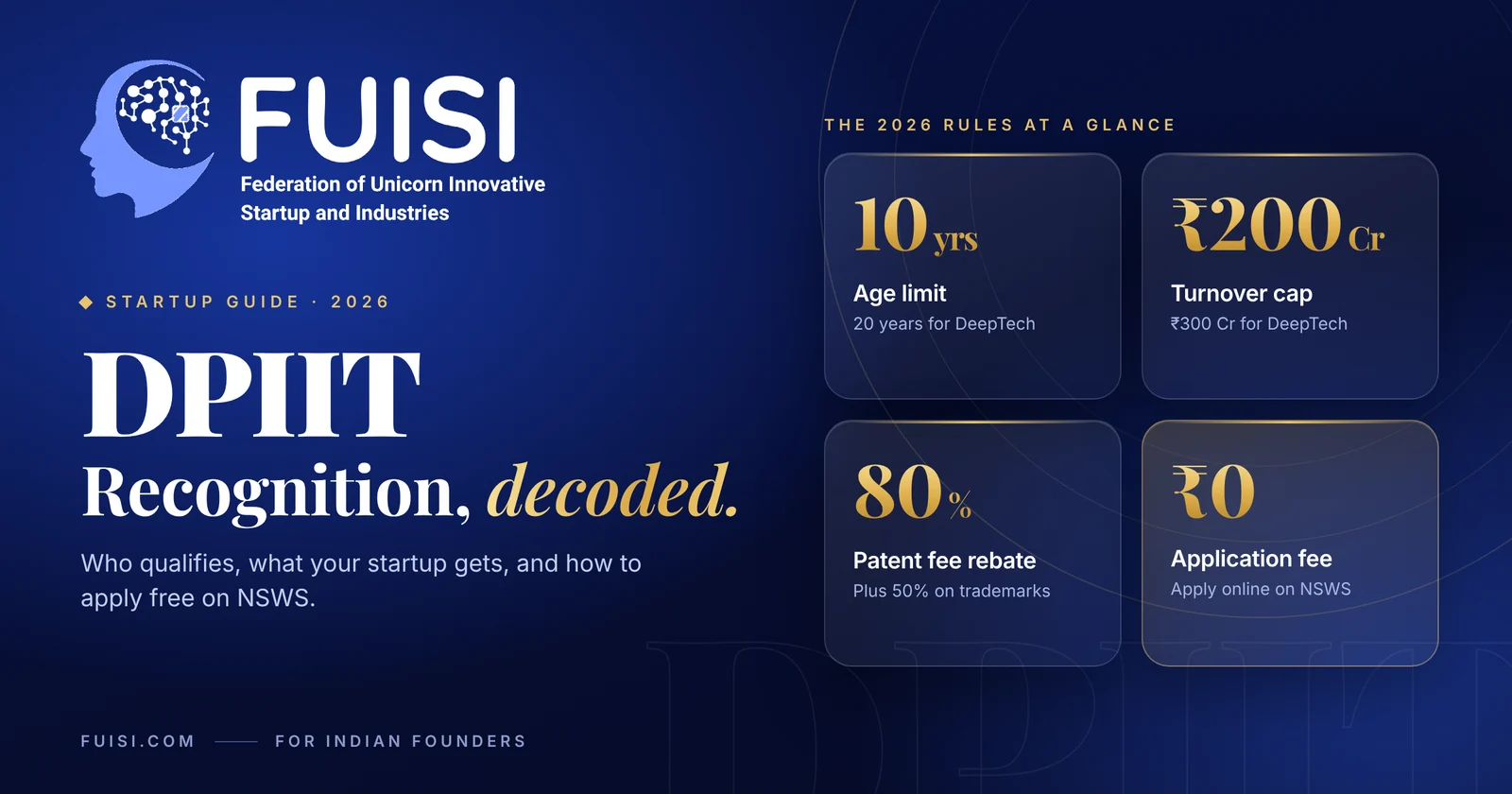
- Who can apply: Private Limited Companies, LLPs, registered partnership firms and eligible co-operative societies that are up to 10 years old with turnover of up to ₹200 crore.
- Where to apply: Online on the National Single Window System (NSWS).
- Cost: Free. There is no government fee for the application or the certificate.
- Key benefits: Self-certification, patent and trademark fee rebates, eligibility for the Section 80-IAC tax holiday, relaxed government tender rules and a faster exit process.
What Is DPIIT Recognition?
DPIIT stands for the Department for Promotion of Industry and Internal Trade. It works under the Ministry of Commerce and Industry, Government of India.
DPIIT recognition is a status given to eligible startup entities under the Startup India initiative. It aims to support innovation, promote entrepreneurship, help businesses grow and create jobs. Startups that get DPIIT recognition can use government-backed benefits and support programs.
This recognition allows startups to access schemes, relaxations and assistance programs. These can help them handle business challenges and look for growth opportunities.
DPIIT recognition is not the same as company incorporation. A startup must first be registered as an entity. Only then can it apply for DPIIT recognition if it meets the required eligibility conditions. If you have not registered your business yet, start with our step-by-step guide on how to register a startup in India.
Eligibility Criteria for DPIIT Recognition
Before applying for DPIIT recognition, entrepreneurs must check that their business fully satisfies the eligibility requirements set by the government. The eligibility criteria generally include the following:
1. Eligible Business Structure
The startup must be registered in India under an eligible business structure, such as:
- Private Limited Company
- Limited Liability Partnership (LLP)
- Registered Partnership Firm
- Co-operative Society or eligible Multi-State Co-operative Society
The entity must possess valid incorporation or registration documents that support its application. Sole proprietorships are not eligible for DPIIT recognition.
2. Business Age
For startup recognition, the entity should generally be within ten years from the date of incorporation or registration.
Eligible DeepTech startups can qualify for a recognition period of up to twenty years, subject to the applicable criteria.
3. Turnover Limit
For startup recognition, the entity's turnover should not exceed ₹200 crore in any financial year since incorporation or registration.
For DeepTech startups, the applicable turnover limit is ₹300 crore in any financial year, subject to the relevant conditions.
4. Innovation, Development or Scalability
The startup should be working towards innovation, development or improvement of products, processes or services.
Alternatively, its business model should show scalability and the potential to generate employment or create wealth.
The business must be able to explain how its operations, product, service or business model contribute to innovation or growth potential.
5. Original Business Entity
The startup should not have been formed by splitting up or reconstructing an existing business.
This requirement helps ensure that recognition is given to genuine startup entities rather than to businesses created by restructuring existing operations to obtain startup benefits.
Eligibility conditions and applicable exceptions should be verified against the latest government notification before you submit an application.
What Are the Benefits of DPIIT Recognition?
Obtaining DPIIT recognition can help eligible startups access various government-supported benefits and business opportunities under the Startup India initiative.
The Startup India recognition benefits are designed to promote innovation, reduce compliance requirements, provide intellectual property support and improve access to government schemes, funding opportunities and procurement platforms.
1. Self-Certification Under Labour and Environmental Laws
DPIIT-recognised startups may be eligible for self-certification under applicable labour and environmental laws.
This initiative aims to reduce compliance burdens and allow startups to focus on business operations, product development and growth.
Eligible startups can self-certify their compliance with applicable labour and environmental laws in accordance with government guidelines. These provisions also offer inspection-related relaxations, subject to prescribed conditions and regulatory requirements.
2. Intellectual Property Rights Support
Startups that develop innovative products, services, technologies or processes need to protect their intellectual property. DPIIT-recognised startups get:
- An 80% rebate on patent filing fees compared with other companies.
- A 50% rebate on trademark filing fees.
- Fast-tracked examination of their patent applications.
These benefits help startups protect their intellectual property while reducing patent and trademark filing expenses.
Note: The Startup Intellectual Property Protection (SIPP) scheme, which covered the fees of government-empanelled IP facilitators, ended on 31 March 2026. Unless the scheme is renewed, startups should budget for professional fees when filing patents and trademarks.
3. Income Tax Benefits Under Section 80-IAC
Eligible startups can apply for income tax benefits under Section 80-IAC, subject to the applicable eligibility conditions and approval requirements.
Under this provision, eligible startups may receive a 100% deduction on profits and gains from their eligible business for three consecutive years out of their first ten years from incorporation. To claim it:
- The startup must have DPIIT recognition.
- It must be incorporated as a Private Limited Company or Limited Liability Partnership (LLP).
- It must be incorporated on or after 1 April 2016 and before 1 April 2030.
- It must fulfil the applicable eligibility criteria and obtain the required approval or certification.
DPIIT recognition alone does not automatically provide this tax benefit. Startups must complete the separate application and approval process under the applicable provisions. As the new Income-tax Act applies from 1 April 2026, confirm the current section reference with your chartered accountant.
4. Easier Access to Government Procurement Opportunities
DPIIT-recognised startups can benefit from relaxations in certain government procurement requirements. These provisions allow eligible startups to participate in government tenders, including on the Government e-Marketplace (GeM).
Depending on the tender conditions and procurement guidelines, eligible startups may receive exemptions from:
- Prior experience requirements.
- Prior turnover requirements.
- Earnest Money Deposit (EMD) requirements, where applicable.
These provisions enable startups to supply products and services to government departments and public sector organisations.
5. Access to Funding-Related Opportunities
Recognised startups can access government-supported funding initiatives such as the Startup India Seed Fund Scheme and investors backed by the Fund of Funds for Startups, along with startup programmes and investor-connect platforms. Our complete 2026 guide to startup funding in India explains these routes in detail.
However, DPIIT recognition does not guarantee funding, investment or financial assistance. Each scheme or funding programme has its own eligibility criteria and application process.
6. Faster Winding-Up Process
DPIIT-recognised startups may benefit from provisions designed to simplify business closure.
Under the Insolvency and Bankruptcy Code, 2016, eligible startups with simple debt structures or those meeting specified criteria may be wound up within 90 days of applying for winding up on a fast-track basis, compared with 180 days for other companies.
This provision helps founders complete closure procedures within a defined timeline and redirect their resources towards new opportunities. The 90-day timeline is subject to applicable legal requirements and eligibility conditions.
7. Access to Startup India Programmes and Support
DPIIT-recognised startups may benefit from Startup India programmes, mentorship opportunities, startup challenges, business support initiatives and other ecosystem resources.
These opportunities help startups strengthen business development, connect with relevant stakeholders and access government-supported programmes. Founders can also find mentors and industry experts through FUISI's Startup Mission and meet investors at FUISI events.
The availability of these opportunities depends on the specific programme, eligibility criteria and application requirements.
How to Apply for DPIIT Recognition?
The application for DPIIT recognition is completed online through the National Single Window System (NSWS). Eligible startups can apply by creating an account and submitting the required details and documents through the designated application.
Step 1: Create an Account on the NSWS Portal
Visit the National Single Window System (NSWS) portal and create an account if you do not already have one. Complete the registration process using the required details to access the portal and its available approvals.
Step 2: Log In to Your Account
After creating your account, log in to the NSWS portal using your registered credentials. The dashboard provides access to central government approvals and applications available through the platform.
Step 3: Add the Startup Recognition Application
From the NSWS dashboard:
- Click on the Add Approvals option.
- Navigate to Central Approvals.
- Search for Registration as a Startup.
- Add the application to your dashboard.
Step 4: Fill in the Application Details
Complete the application form with the required information about your business. The details include:
- Name of the entity.
- Entity type and incorporation details.
- PAN details.
- Business activity and industry information.
- Information about the startup's innovation, product, service or business model.
- Details of directors, partners or authorised representatives, as applicable.
Step 5: Upload the Required Documents
Upload the supporting documents required for the application. These documents help verify the existence of the entity and the information provided in the application.
Step 6: Submit the Application
After completing the application and uploading the required documents, review all the information carefully. Then submit the application through the NSWS portal for verification and processing.
Step 7: Track the Application Status
After submission, applicants can track their application status through the NSWS dashboard. If additional information, documents or clarification is requested during the review, respond through the portal. Once the application is approved, the startup can access its recognition certificate through the designated portal.
Documents Required for DPIIT Registration
Entrepreneurs should make sure they have all the documents and information ready before starting the application for DPIIT recognition. The documents and details usually needed include:
- Certificate of Incorporation or Registration: Proof that the business has been legally registered.
- PAN Card: The PAN of the registered business entity.
- Business Details: A description of the business, including what it does, the products or services offered and any innovation involved.
- Director or Partner Details: Information about the directors, partners or authorised representatives of the business.
- Authorisation Documents: An authorisation letter or any other supporting document, if applicable.
- Supporting Information: Website links, pitch decks, videos, product descriptions or other details that support the startup's application.
For the wider set of legal paperwork founders need, see our startup registration and legal assistance checklist.
DPIIT Recognition vs DPIIT Registration: What Is the Difference?
Many entrepreneurs looking for government benefits for their startup mix up the terms DPIIT recognition and DPIIT registration. It is important to know what each term really means:
| Term | What It Means |
|---|---|
| Company incorporation | Creates your business as a legal entity, for example on the MCA portal. This always comes first. |
| DPIIT registration | The common search term for applying for startup recognition on the NSWS portal. |
| DPIIT recognition | The official status, with a Certificate of Recognition, that your startup receives once the application is approved. |
DPIIT registration does not replace business incorporation. A startup has to be set up as an eligible entity first, and final approval depends on whether it meets the rules and whether its documents are correct.
Important Things to Know Before Applying
Before submitting an application for DPIIT recognition, entrepreneurs should keep these important considerations in mind:
- Recognition is not automatic. The application must satisfy the eligibility requirements and undergo the required verification.
- Benefits require applications. Certain tax exemptions, funding schemes and other benefits require separate applications or approvals.
- Compliance obligations continue. DPIIT recognition does not remove the statutory, financial or legal compliance requirements that apply to a business.
- Documents should be accurate. The information submitted should be consistent with the entity's records.
- Apply only through the official portal. Use the designated government platform with your own business details and credentials. The application is free, so be careful of anyone charging for the certificate itself.
How FUISI Helps Startups With Government Schemes
Getting recognised is only the first step. The real value comes from using the benefits it unlocks. FUISI's Gov Schemes Portal helps founders find the schemes that match their startup, and FUISI's advisory team helps members prepare applications and follow up with the departments concerned.
FUISI members also get access to mentors, investor connects and a network of founders across India. Explore FUISI membership to see what fits your startup.
Frequently Asked Questions (FAQs)
1. What is DPIIT recognition?
DPIIT recognition is a status given to eligible startups under the Startup India initiative. It allows qualifying startups to access government benefits, programmes and support measures.
2. Who is eligible for DPIIT recognition?
Eligible entities include Private Limited Companies, registered Partnership Firms, Limited Liability Partnerships and certain Co-operative Societies registered in India. They must meet the rules related to age, turnover, innovation and other criteria.
3. Is DPIIT recognition the same as company registration?
No. Company registration is what makes a business a legal entity under law. DPIIT recognition is a status given only to eligible startups under the Startup India initiative.
4. How can I apply for DPIIT recognition?
Eligible startups can apply online on the National Single Window System (NSWS). Create an account, go to Central Approvals, add Registration as a Startup, fill out the form, upload the documents and submit it for review.
5. Is DPIIT recognition free?
Yes. There is no application fee for DPIIT Startup Recognition. Make sure to apply on the official government website and avoid third-party platforms.
6. Does DPIIT recognition provide income tax exemption?
Not automatically. Startups must meet the conditions and apply separately for tax benefits under Section 80-IAC if they are eligible.
7. What are the Startup India recognition benefits?
Benefits include self-certification under labour and environmental laws, rebates on patent and trademark fees, relaxations in government procurement, access to startup programmes, and eligibility to apply for tax benefits and funding schemes.
8. Can a startup apply for DPIIT recognition before launching its product?
Yes. Startups can apply before launching their product or service, as long as they meet all requirements and can show their business model, innovation or scalability in the application.
9. How can I check my DPIIT recognition application status?
You can check the status of your application on your NSWS dashboard. If more information is needed, the authorities will contact you through the system.
10. Is DPIIT recognition mandatory for every startup?
No. DPIIT recognition is not required to start or run a business. It is needed to access certain benefits and programmes under the Startup India initiative.
11. How long is DPIIT recognition valid?
Recognition applies while the entity still meets the startup definition: up to 10 years from incorporation (20 years for recognised DeepTech startups), as long as turnover has not crossed ₹200 crore (₹300 crore for DeepTech) in any financial year.
12. Can a sole proprietorship get DPIIT recognition?
No. A sole proprietorship is not eligible. The business must be a Private Limited Company, an LLP, a registered partnership firm or an eligible co-operative society.
Conclusion
DPIIT recognition is an opportunity for eligible startups in India to access government support, business development initiatives and various benefits.
Understanding the eligibility rules, preparing the documents and completing the application through the National Single Window System can make the process smoother.
From helping with patents and trademarks to easing government procurement rules and opening doors to tax benefits and funding, DPIIT recognition can support startups at different stages of growth.
Entrepreneurs should go through the rules carefully and make sure their application is complete and accurate before submitting it. For more information on startup initiatives, business registration and available support, visit the FUISI Gov Schemes Portal.