
Introduction
Starting a business is an exciting step for entrepreneurs who want to turn their ideas into successful ventures. However, before beginning business operations, understanding the requirements and registration process is essential. India offers different business structures and online registration facilities that help entrepreneurs establish their businesses through the appropriate government platforms.
Understanding how to register a startup in India can help founders make better decisions about selecting a business structure, preparing the required documents and completing the necessary registration formalities. The process generally involves choosing a business entity, completing incorporation or registration formalities and obtaining relevant approvals based on the nature of the business.
The startup registration process also includes a step for entrepreneurs who want to obtain recognition under the Startup India initiative. DPIIT recognition is different from company incorporation and allows eligible startups to access certain government-supported benefits and opportunities.
This guide explains the steps involved in startup registration in India, the documents generally required and the important considerations entrepreneurs should understand before starting their business in 2026.
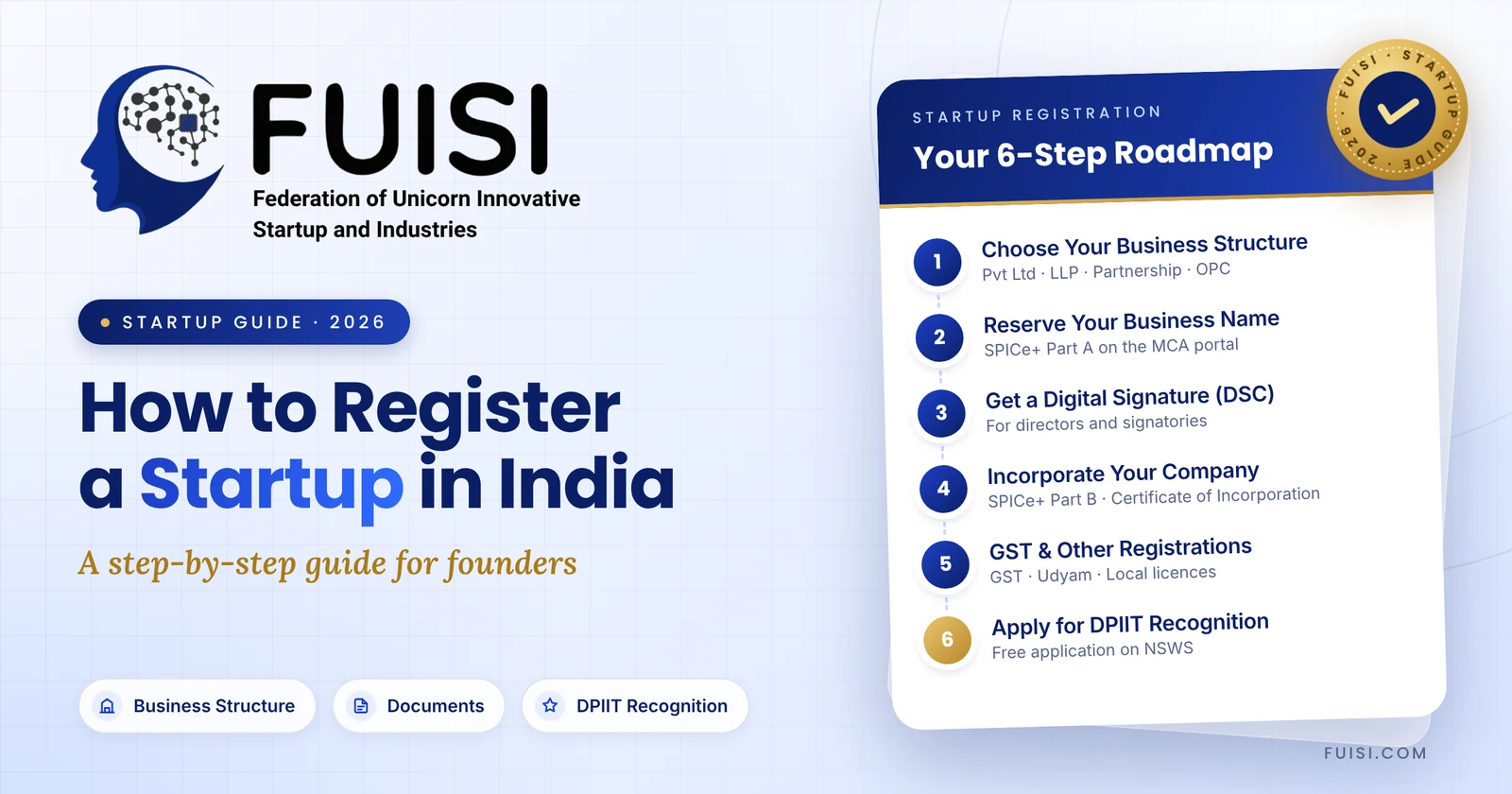
Quick Summary: 6 Steps to Register a Startup in India
- Choose the right business structure.
- Select and check your business name.
- Obtain a Digital Signature Certificate (DSC).
- Complete the company incorporation process on the MCA portal.
- Apply for GST and other required registrations.
- Apply for DPIIT Startup Recognition on the National Single Window System (NSWS).
What Is Startup Registration in India?
Startup registration refers to the process of establishing a business entity under the applicable laws and regulations in India. Entrepreneurs can choose a business structure depending on their business model, ownership requirements, operational plans and future objectives.
Common business structures include:
- Private Limited Company
- Limited Liability Partnership (LLP)
- Registered Partnership Firm
- One Person Company (OPC)
- Sole Proprietorship
Each structure has its own legal requirements, compliance responsibilities and operational considerations. Therefore, entrepreneurs should understand these differences before selecting a business structure. The table below gives a quick comparison.
| Business Structure | Best Suited For | Owner Liability | Registered With | Eligible for DPIIT Recognition? |
|---|---|---|---|---|
| Private Limited Company | Startups planning to raise investment or offer ESOPs | Limited | MCA (SPICe+) | Yes |
| Limited Liability Partnership (LLP) | Service and professional businesses run by partners | Limited | MCA (LLP incorporation) | Yes |
| Registered Partnership Firm | Small businesses with two or more partners | Unlimited | State Registrar of Firms | Yes, if registered |
| One Person Company (OPC) | A single founder who wants limited liability | Limited | MCA (SPICe+) | Usually, as a type of private company |
| Sole Proprietorship | Very small, single-owner businesses | Unlimited | No single registration (GST, Udyam or local licences as needed) | No |
In addition to business incorporation, eligible businesses can apply for recognition under the Department for Promotion of Industry and Internal Trade (DPIIT) through the Startup India initiative.
It is important to understand that registering a company and obtaining DPIIT startup recognition are two separate processes.
How to Register a Startup in India: Step-by-Step Guide
Entrepreneurs planning to establish a business should follow the registration procedure according to their selected business structure. The following steps explain the process involved in establishing a startup in India.
Step 1: Choose the Right Business Structure
The first step is selecting a legal structure for your startup. This decision affects business ownership, legal responsibilities, compliance requirements and future growth opportunities.
The common options include:
- Private Limited Company: A Private Limited Company is a structure for businesses planning to operate with shareholders and directors. It is a separate legal entity and is commonly considered by startups planning future investment and expansion.
- Limited Liability Partnership (LLP): An LLP combines features of a partnership with liability protection for its partners. It is another option for entrepreneurs who want to establish a registered business structure with lighter compliance.
- Registered Partnership Firm: A registered partnership firm is formed when two or more individuals agree to operate a business under the Indian Partnership Act, 1932.
- One Person Company (OPC): An OPC allows a single founder to run a company with limited liability.
- Sole Proprietorship: The simplest form of business, owned and run by one person. It is quick to start, but the owner has unlimited liability and it is not eligible for DPIIT recognition.
Before making a decision, founders should consider their business requirements and long-term objectives.
Step 2: Select and Check Your Business Name
After selecting a business structure, the next step is choosing a name for the proposed business.
The name should be unique and comply with the registration requirements. Entrepreneurs should check whether the proposed name is already being used by another registered entity or conflicts with an existing trademark.
For company incorporation, name reservation can be completed through the Ministry of Corporate Affairs (MCA) portal using the online services. For companies, the SPICe+ application provides a facility for name reservation through Part A. LLPs can reserve their name through the LLP name reservation service on the same portal.
Step 3: Obtain a Digital Signature Certificate (DSC)
A Digital Signature Certificate is required for signing applicable incorporation forms and documents.
Proposed directors or authorised individuals may need a DSC depending on the selected business structure and filing requirements.
Since company incorporation is completed online, digital signatures are an important part of submitting the required forms to the MCA.
Step 4: Complete the Company Incorporation Process
The next step in company registration in India is completing the incorporation formalities through the government portal.
For a Private Limited Company, the MCA provides the SPICe+ (Simplified Proforma for Incorporating Company Electronically Plus) integrated web form for company incorporation.
The SPICe+ process includes:
- SPICe+ Part A for company name reservation.
- SPICe+ Part B for incorporation-related details and services.
- Filing of the e-MoA and e-AoA (electronic Memorandum and Articles of Association).
- Submission of the required incorporation information and documents.
- Payment of government fees, where required.
- Verification and processing of the submitted application.
Depending on the application and eligibility, integrated services may include applications for Director Identification Number (DIN), PAN and TAN. The linked AGILE-PRO-S form can also be used to apply for GSTIN, EPFO and ESIC registration and to open a company bank account.
After processing and approval, the company receives its Certificate of Incorporation with a Corporate Identification Number (CIN).
The applicable incorporation procedure may differ for LLPs and registered partnership firms.
Step 5: Apply for Required Registrations
After completing the business registration, entrepreneurs should identify any additional registrations or approvals applicable to their business.
These may depend on the business structure, location, industry and nature of operations. Common examples include:
- GST registration: Required when applicable under GST regulations, such as when turnover crosses the threshold or for certain inter-state and e-commerce sales.
- Udyam registration: A free online registration for MSMEs that opens access to many government schemes for startups and MSMEs.
- Shops and Establishments registration or a trade licence from the state or local body.
- Sector-specific licences, such as FSSAI for food businesses or an Import Export Code (IEC) for cross-border trade.
Entrepreneurs should check the government guidelines before applying for additional registrations. Newly incorporated companies should also note early compliance deadlines: the first auditor must be appointed within 30 days of incorporation, and the declaration for commencement of business must be filed within 180 days.
Step 6: Apply for DPIIT Startup Recognition
After establishing the business entity, entrepreneurs can apply for recognition under the Startup India initiative. DPIIT recognition is separate from company incorporation.
Eligible entities can apply through the National Single Window System (NSWS) by selecting the startup recognition application.
The general process includes:
- Create an account on the NSWS portal.
- Log in to the account.
- Select the option to add approvals.
- Add the Registration as a Startup application.
- Complete the application form with the required business information.
- Upload the supporting documents.
- Submit the application for review.
The application requires details about the business and its work towards innovation, development or improvement of products, services or processes, or its potential for employment generation and wealth creation.
The application for DPIIT Startup Recognition is free of charge, and the Ministry of Commerce and Industry does not charge any fee for issuing the Certificate of Recognition.
After approval, the eligible business receives a DPIIT Certificate of Recognition. To understand why founders should prioritise this step, read why Indian startups should prioritise getting registered ahead of DPIIT recognition.
Understanding the Startup Registration Process
The startup registration process involves different stages, and entrepreneurs should understand the difference between establishing a legal business entity and obtaining government startup recognition.
Business Incorporation
Business incorporation establishes the identity of the business under the applicable laws. For example, a Private Limited Company is incorporated through the MCA portal, while LLP registration follows the LLP incorporation procedure.
Startup India Registration
Registration on the Startup India portal provides access to the platform and its resources. However, portal registration alone does not mean that the business has received DPIIT recognition.
DPIIT Recognition
DPIIT recognition is granted to business entities that satisfy the applicable startup recognition criteria. Under the revised startup framework notified in February 2026, the general criteria include:
- The entity should be incorporated or registered as a Private Limited Company, Limited Liability Partnership or registered partnership firm. Eligible cooperative societies were added under the 2026 framework, while sole proprietorships are not eligible.
- It should generally be within 10 years from its incorporation or registration date.
- Its turnover should not exceed ₹200 crore in any financial year since incorporation or registration.
- It should work towards innovation, development or improvement of products, services or processes, or have a scalable business model with high potential for employment generation or wealth creation.
- It should not have been formed by splitting up or reconstructing an existing business.
Separate eligibility provisions apply to recognised Deep Tech startups, which can be recognised for up to 20 years with a turnover limit of ₹300 crore.
Benefits of DPIIT Recognition for Startups
DPIIT recognition is optional, but it unlocks support that can make a real difference in the early years of a startup:
- Tax benefits: Eligible recognised startups can apply for a three-year income tax holiday under Section 80-IAC, which needs a separate approval.
- Easier compliance: Self-certification under certain labour and environmental laws.
- Intellectual property support: Fast-track patent examination and rebates on patent and trademark filing fees.
- Funding access: Eligibility for programmes such as the Startup India Seed Fund Scheme and investors backed by the government's Fund of Funds. Our complete 2026 guide to startup funding in India explains these routes in detail.
- Government tenders: Relaxed prior-experience and turnover conditions in public procurement.
To find schemes that match your startup, explore the FUISI Gov Schemes Portal.
Startup Registration Documents: What Do You Need?
Preparing the necessary documents in advance can help entrepreneurs complete registration formalities more efficiently.
The startup registration documents required depend on the selected business structure and the type of registration being requested.
Documents Generally Required for Company Incorporation
For a Private Limited Company, the documents and information generally include:
- PAN details of proposed directors and subscribers.
- Identity proof of directors and subscribers.
- Address proof of directors and subscribers.
- Registered office address proof.
- Rent agreement and No Objection Certificate (NOC) from the property owner, if the office is rented.
- Memorandum of Association (MoA).
- Articles of Association (AoA).
- Digital Signature Certificates for signatories.
- Incorporation forms (SPICe+ and linked forms).
Additional documents may be required depending on the circumstances of the applicants and the proposed company.
Documents for LLP Registration
For LLP registration, the required information and documents may include:
- PAN and identity proof of designated partners.
- Address proof of designated partners.
- Registered office address proof.
- Digital Signature Certificates, where applicable.
- Details of proposed partners and their capital contribution.
- LLP incorporation form.
- Applicable declarations.
Documents Required for DPIIT Recognition
For Startup India recognition, applicants generally need:
- Certificate of Incorporation or Registration.
- PAN details of the business entity.
- Details of the representative.
- Information describing the startup's business activities.
- An explanation of its innovation, development, improvement, scalability or employment and wealth creation potential.
- Supporting material such as a pitch deck, website or patent details, if available.
The exact requirements should be checked on the official government portal before submission. For a wider list of legal paperwork, see our startup registration and legal assistance checklist for founders.
Important Things to Consider Before Registering a Startup
Before starting the registration process, entrepreneurs should keep these important considerations in mind.
Select the Appropriate Business Structure
Choose a business structure based on ownership, liability, business objectives and future requirements.
Entrepreneurs looking for business networking and support opportunities can explore FUISI Membership to learn more about membership opportunities.
Keep Documents Accurate
Ensure that the information submitted in registration applications matches the supporting documents. Even small mismatches in names, addresses or dates can lead to delays or rejection.
Understand Compliance Requirements
Different business structures have legal and compliance responsibilities. Entrepreneurs should understand the requirements before beginning operations. Guidance from experienced mentors helps here, and FUISI's Startup Mission connects young founders with mentors and industry experts.
Check DPIIT Eligibility Separately
Business incorporation does not automatically provide DPIIT recognition. Eligible entities must complete the recognition application.
Use Official Government Portals
Entrepreneurs should use the MCA and Startup India or NSWS platforms for relevant registration and recognition applications, and be careful of websites that only look official.
How FUISI Supports Founders After Registration
Registering a startup is the first milestone. FUISI, the Federation of Unicorn Innovative Startup and Industries, supports founders at the next stage through:
- Government scheme advisory: FUISI's advisory team helps members find matching schemes, prepare applications and follow up with the departments concerned. Talk to an advisor if you need help.
- Mentorship and networking: Access to experienced founders, sector experts and investors through the FUISI community and its city chapters.
- Events and investor connects: Programmes such as INNOFEST India bring founders, investors and policymakers together. See the upcoming FUISI events.
- Member benefits: See the full list of exclusive FUISI member benefits.
Frequently Asked Questions (FAQs)
1. How do I register a startup in India?
To register a startup in India, entrepreneurs first choose a business structure that fits their needs, complete the paperwork for incorporation or registration and get the required approvals. Businesses that qualify can then apply for DPIIT recognition on the NSWS portal.
2. What is the startup registration process in India?
The startup registration process usually includes picking a business structure, reserving a business name if needed, getting documents ready, finishing the incorporation steps and applying for registrations or DPIIT recognition if the business is eligible.
3. What are the startup registration documents required?
The documents needed for startup registration vary depending on the business structure. Common documents include PAN details, proof of identity, proof of address, information about the registered office, incorporation documents and any necessary declarations.
4. Are company registration and DPIIT recognition the same?
No. Company registration creates a business entity, while DPIIT recognition is a separate government recognition for eligible startups under the Startup India initiative.
5. Can an LLP apply for DPIIT startup recognition?
Yes. Eligible Limited Liability Partnerships can apply for DPIIT startup recognition if they meet the required eligibility conditions.
6. Is DPIIT recognition mandatory for every startup?
No. DPIIT recognition is not required for every business. However, startups that want to take advantage of the benefits and exemptions under the Startup India initiative need to get this recognition.
7. Which government portal is used for company registration in India?
The Ministry of Corporate Affairs (MCA) portal is used for company incorporation. The SPICe+ web form is the application used for company incorporation services.
Conclusion
Starting and running a business needs guidance, planning and a clear understanding of the registration and compliance process. Choosing the right business structure and finishing the registration steps are both important in building a strong base for your startup.
With the right support and access to resources, entrepreneurs can handle business processes more easily and with more confidence. FUISI is here to help businesses and entrepreneurs with guidance, resources and initiatives that make the business world more informed and connected.